New magneto-ionic materials to strengthen digital security
Researchers at the UAB and the ICN2 have developed an innovative system based on magneto-ionic dot arrays, a type of material with magnetic properties that can be modified and reconfigured by voltatge gating. This technology can generate true random numbers and unclonable fingerprints for each electronic device, paving the way for new approaches to device authentication and data protection. The study is featured on the cover of Advanced Science.
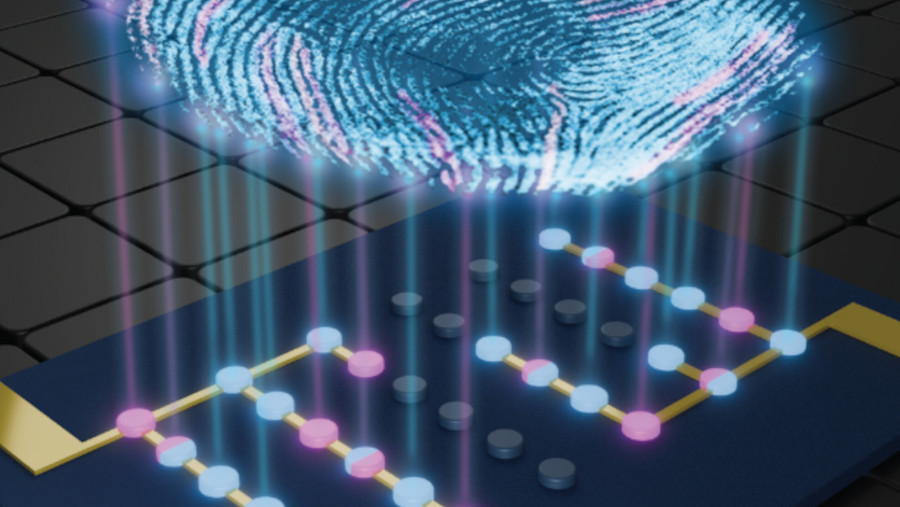
As digital tecnologies generate increasing amounts of information, protecting data against cyberattacks and conterfeiting is becoming ever more challenging. A research team from the Universitat Autònoma de Barcelona (UAB) and the Institut Català de Nanociència i Nanotecnologia (ICN2) presents a new approach to developing more robust security systems: ones that modify the properties of magneto-ionic materials with voltatge in a stochastic and probabilistic manner to create unique, unclonable device fingerprints.
This strategy, devised by a team led by Professor Jordi Sort, ICREA researcher and director of the Nanomaterials for Advanced Memories and Computing Group at the ICN2, the Nanomagnetics and Nanomechanics Group of the UAB Department of Physics, and the Nanomaterials for Advanced Memory and Computing Group at the ICN2; and by Irena Spasojevic, postdoctoral researcher at the Nanomaterials for Advanced Memory and Computing Group at ICN2 and affiliated with the UAB Department of Physics. The study, selected as a cover article for the journal Advanced Science with an image designed by Dámaso Torres from the ICN2 Marketing and Communication Department, also involved researchers from the Istituto Nazionale di Ricerca Metrologica (INRiM) in Italy.
In this work, researchers used an array of nanodots made from a magneto-ionic material known as iron cobalt nitride (FeCoN). This material’s magnetic behaviour can be controlled electrically. When a voltage is applied to initially paramagnetic FeCoN dots, nitrogen ions migrate within the material to form ultrathin layers with ferromagnetic properties that can adopt different magnetic configurations depending on their thickness.
The main innovation of this study lies in the ability to engineer the statistical distribution of magnetic configurations across the array, while preserving the inherent unpredictability of the magnetic states of individual dots, which is key to achieving unclonable devices. These configurations include the single-domain state, where magnetisation points in a specific direction, and the vortex state, where the magnetic moments form a circular, swirling pattern.
A unique digital fingerprint for each device
The researchers demonstrate that this combination of behaviours has several potential applications. Firstly, the random orientation of single-domain states and the direction in which vortices rotate can be used to generate true random numbers (as opposed to pseudo-random numbers created by software or hackable passwords). Secondly, the arrays can act as physically unclonable functions. This means that each device has its own magnetic “digital fingerprint”, impossible to predict or reproduce, which can be used to identify each unique device. By repeatedly measuring the magnetic response of individual dots, it is possible to distinguish one device from another by leveraging the unique probabilities of the dots to adopt one state or the other.
This study highlights the potential of magneto-ionic materials in the development of more efficient, robust data security systems. As their properties can be reconfigured, the magnetic fingerprints of the devices can be updated even after fabrication, allowing them to be reprogrammed in the event of a security breach. While further research is needed, these results pave the way for a new paradigm in data security, where protection is intrinsically integrated in the materials’ physical properties, offering an alternative to conventional software-based passwords vulnerable to cyberattacks.
Reference article:
Spasojevic, I., Celegato, F., Magni, A., Tiberto, P. and Sort, J. Voltage-Reconfigurable Magneto-Ionic Nanolayers in Dot Arrays for Probabilistic, Materials-Engineered Security Primitives. Advanced Science 13 (2026) e76814. https://doi.org/10.1002/advs.76814.