Seven projects ranging from rural agroecology to inclusive technology win the Eines Awards 2026
Aresta, The CoMAKING Space, the School Happiness Programme, the Living Lab Textile Hub, Bandada, Bruixes Montornès and TEAstimo Molt! were awarded in this year's edition in which a total of 14 initiatives received mentions and 17,500 euros were awarded in cash prizes.
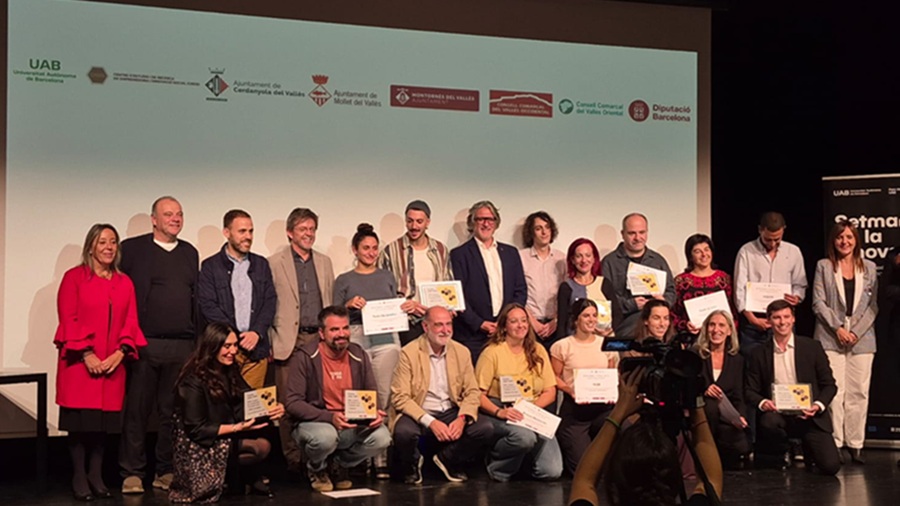
Seven social transformation projects—spanning the Catalan, provincial, Vallès, and local levels—have been honoured with the Eines 2026 Awards, which recognise the best social innovation and transformation initiatives in the region. The awards, which include a cash prize of 1,500 euros for winners and 750 euros for finalists (3,000 and 1,000 euros, respectively, for the Catalan-level category), were presented this Tuesday 20 October, at a ceremony held at the Margarida Xirgu Theatre in Montornès del Vallès. In total, fourteen projects—seven winners and seven finalists—were recognised, with a combined prize pool of 17,500 euros.
The awards, promoted by the Chair in Entrepreneurship and Social Innovation at the Centre for Studies and Research in Entrepreneurship and Social Innovation (CREIS) of the Universitat Autònoma de Barcelona, receive the support of the municipal councils of Montornès del Vallès, Cerdanyola del Vallès, and Mollet del Vallès, the county councils of Vallès Oriental and Vallès Occidental, and the Barcelona Provincial Council. The winners of this edition are:
National award
The Eines Award for the project with an impact across Catalonia has gone to L'Aresta, a non-profit cooperative of associated workers from Santa Coloma de Queralt which, since 2013, has been driving the agroecological transition and social transformation of the rural world through a social, solidarity and feminist economy. It combines the production of agroecological bread, education and community action, applied research and local mobilisation to build food sovereignty, preserve cultivated biodiversity, and develop replicable models of agroecological transition in rural settings.
The Barcelona Provincial Council's award for digital transformation with social impact has gone to TEAstimo Molt!, an educational and technological innovation project designed at the Palma de Mallorca School to facilitate the emotional and sensory self-regulation of children with autism spectrum disorder (ASD). The students have designed and programmed three devices using micro:bit: a portable sound level meter, a visual traffic light that regulates the volume in the classroom, and a plush toy with artificial intelligence that allows emotions to be expressed through pictograms.
Vallès regional award
In Vallès Oriental, the award went to the Happiness in Schools programme, which introduces emotional education and psychological well-being into the educational system using a methodology based on scientific evidence. Implemented since 2019 in primary and secondary schools across the region, the programme combines positive psychology, emotional intelligence, and healthy habits through six practical sessions; according to the project's findings, the well-being of participants increases significantly within three months.
In the Vallès Occidental county, the award has recognised The CoMAKING Space, which democratises access to industry and technical training by removing entry barriers so that self-employed individuals and small entrepreneurs can use professional industrial infrastructure. It does so through an accredited welding school (SEPE/FUNDAE), the employment of young people with no experience and those over 50, and a business incubator.
Three local awards
In Cerdanyola del Vallès, the award went to the Living Lab – Local Circle Circular Revolution Textile Hub, which promotes the circular management of textiles through the repair, customisation and upcycling of recovered clothing, via a zero-kilometre network of local shops and the city's Selective Entry Point (PES). The laboratory combines open workshops with certified social and labour inclusion training pathways and a digital passport per item, with a QR code, that quantifies the recovered waste.
In Mollet del Vallès, the award went to "Bandada. Espais per a joves amb gèneres i sexualitats diverses" [Bandada: Spaces for young people with diverse genders and sexualities], a community project spearheaded by Candela. It offers meeting places, support, and empowerment to young people aged 12 to 25, creates safe environments free from LGTBI-phobic discrimination and violence, and works in a network with families, public services, and local organisations.
In Montornès del Vallès, the prize was awarded to "Bruixes Montornès", a non-profit association dedicated to the traditional ball de bastons and ball de foc dances. Furthermore, the group honours the memory of the women in the town who were accused of and sentenced for witchcraft during the 17th century.
The event opened with a welcome from José Antonio Montero, mayor of Montornès del Vallès, and contributions from Esther Zapater, secretary general of the UAB; Emilio Cordero, president of the Comarcal Council of the Vallès Oriental; and Núria Montserrat Pulido, minister for Research and Universities. The 2026 Entrepreneurship, Economy and Social Innovation Yearbook was presented by Marta Martorell, director of the Digital Society Technologies Research Group, i2cat, and Caterina Riera Panadés, of the Vallès Oriental Cooperative Athenaeum, delivered the lecture "The Social and Solidarity Economy in the Vallès Oriental".
Finalists
The finalists in this edition were: Thematic "Purple Points" (Catalan region)—specialised hubs adapted to specific types of events to prevent gender-based violence; Synusia (digital transformation)—a forensic escape room titled "Case Voss" that turns artificial intelligence into an opponent to strengthen critical thinking in the face of algorithmic opacity; Pit3D (Vallès Occidental)—customised external breast prostheses created using 3D technology for women who have undergone a mastectomy; TECOUS (Vallès Oriental)—a solution that transforms legal texts into useful, intuitive assets; AiQUOS (Cerdanyola del Vallès)—a spin-off from the CSIC and the University of Zurich that has developed electrochemical probes using neuromorphic AI to monitor water quality in real time; the Health School of the Fundació Sanitària Mollet (Mollet del Vallès)—a model for the transfer of health-related knowledge; and Catpèdia Cultura Viva (Montornès del Vallès)—an open platform that preserves oral history as intangible cultural heritage.