Barcelona's municipal rooftops could produce 31% of the tomatoes consumed in the city
A study published in Cities by researchers at ICTA-UAB with collaboration from the CRM's Knowledge Transfer Unit, estimates that 65 hectares of municipal rooftop could supply 31% of the tomatoes consumed in Barcelona each year.
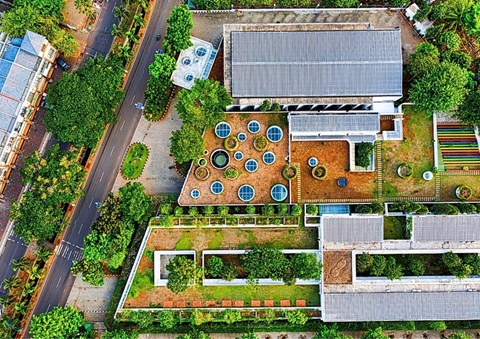
Barcelona has 65 hectares of rooftop distributed across 437 public buildings that could host urban gardens with minimal modification to the buildings themselves. A study quantifies what those roofs could produce if they were fitted with greenhouses for cultivation.
The results show that a single crop cycle of tomatoes yields 8,866 tonnes, equivalent to 31% of the 28,549 tonnes the city is estimated to consume annually. The data are relevant considering that the municipal rooftop area analyzed amounts to just 0.64% of the 101.4 km² covered by Barcelona's buildings.
The work is authored by Diego Maximiliano Macall, Xavier Gabarrell Durany and Sergio Villamayor-Tomas, of the Institut de Ciència i Tecnologia Ambientals (ICTA-UAB), together with David Romero i Sànchez, of the Knowledge Transfer Unit (KTU) at the Centre de Recerca Matemàtica.
For Macall, the agrifood systems through which cities are currently supplied are complex and increasingly exposed both to climate change and to geopolitical tension. "Bringing part of production closer to the point where it is consumed strengthens nutritional and food security," he says. Barcelona's roofs are a surface that already exists and goes largely unused.
However, Macall is cautious and notes that urban agriculture is not going to replace conventional agriculture. "The study does not argue that it should either, but it could be one component of a more diversified and more resilient agrifood system, provided public policy supports it," he indicates.
The study addresses three crops: tomato, bell pepper and lettuce. Macall explains that the selection responded mainly to agronomic viability inside a greenhouse and to economic return per square metre for the grower. Tomato and bell pepper dominate the intensive greenhouse horticulture of Almería, where together they accounted for 63.2% of the 33,250 hectares under cover in the 2022-2023 season, and earlier trials in a building-integrated greenhouse near Barcelona had established that lettuce also performs well under these conditions. On the demand side, all three rank high among the twenty-one most consumed vegetables in Catalonia according to the Household Food Consumption Panel published by the Spanish Ministry of Agriculture, Fisheries and Food.
"Spain has some of the best food consumption statistics I have ever seen," says Macall, who has previously worked in Canada and the United States. "That made the work a great deal easier and gave us considerable confidence in the quality of the data."
The question also has a policy context. The Government of Catalonia has set a target of 50% food self-sufficiency by 2030 and is planning to expand the open-field area dedicated to vegetables, which would most likely come at the expense of land currently under cereals and on sites with unfavourable agronomic conditions for vegetable production.
Tomato generates €9.82 of revenue per square metre harvested, against €3.47 for bell pepper and €0.28 for lettuce, so any allocation driven by economic profitability concentrates heavily on a single crop.
The researchers analyzed different scenarios. In the first scenario, the entire 65 hectares go to tomato, producing 8,866 tonnes, the highest output of the three cases. The second applies a linear programming model that reserves 60% of the surface for tomato -reflecting its share of consumption relative to the other two crops- and assigns the remaining 260,000 square metres to the next most profitable crop. This scenario yields 5,320 tonnes of tomato and 1,014 tonnes of bell pepper, with no space allocated to lettuce at all. The third distributes space in proportion to consumption (60% to tomato and 20% to each of the other two), producing 5,878 tonnes of tomato, 507 tonnes of bell pepper and 78 tonnes of lettuce, a combined total of 6,463 tonnes.
The study considers a more conservative case in which municipal authorities permit greenhouses on only a fraction of the available area. If a 90 m² greenhouse were installed on each of the 437 buildings available -using 6% of the total surface area available- production falls to 535 tonnes of tomato, 153 tonnes of bell pepper and 24 tonnes of lettuce. That 6% of the surface produces roughly 6% of what the full 65 hectares would yield, representing under 2% of the city's annual tomato consumption.
An optimisation model does not stop at the idea that urban agriculture may be worthwhile: it establishes how much could be produced, which crops should be prioritised and how the available space should be distributed. Those results can then be weighed against alternative uses of those same rooftops, such as photovoltaic installation, rainwater collection or green space. The value, according to Macall, lies in "turning very complex questions into information that can be compared, evaluated and, in the end, used to make better decisions."
Article reference: Macall, D. M., Gabarrell Durany, X., Villamayor-Tomas, S., & Romero i Sànchez, D. (2026). A food system innovation: Vegetable production in rooftop greenhouses in Barcelona. Cities, 171, 106698. https://doi.org/10.1016/j.cities.2025.106698