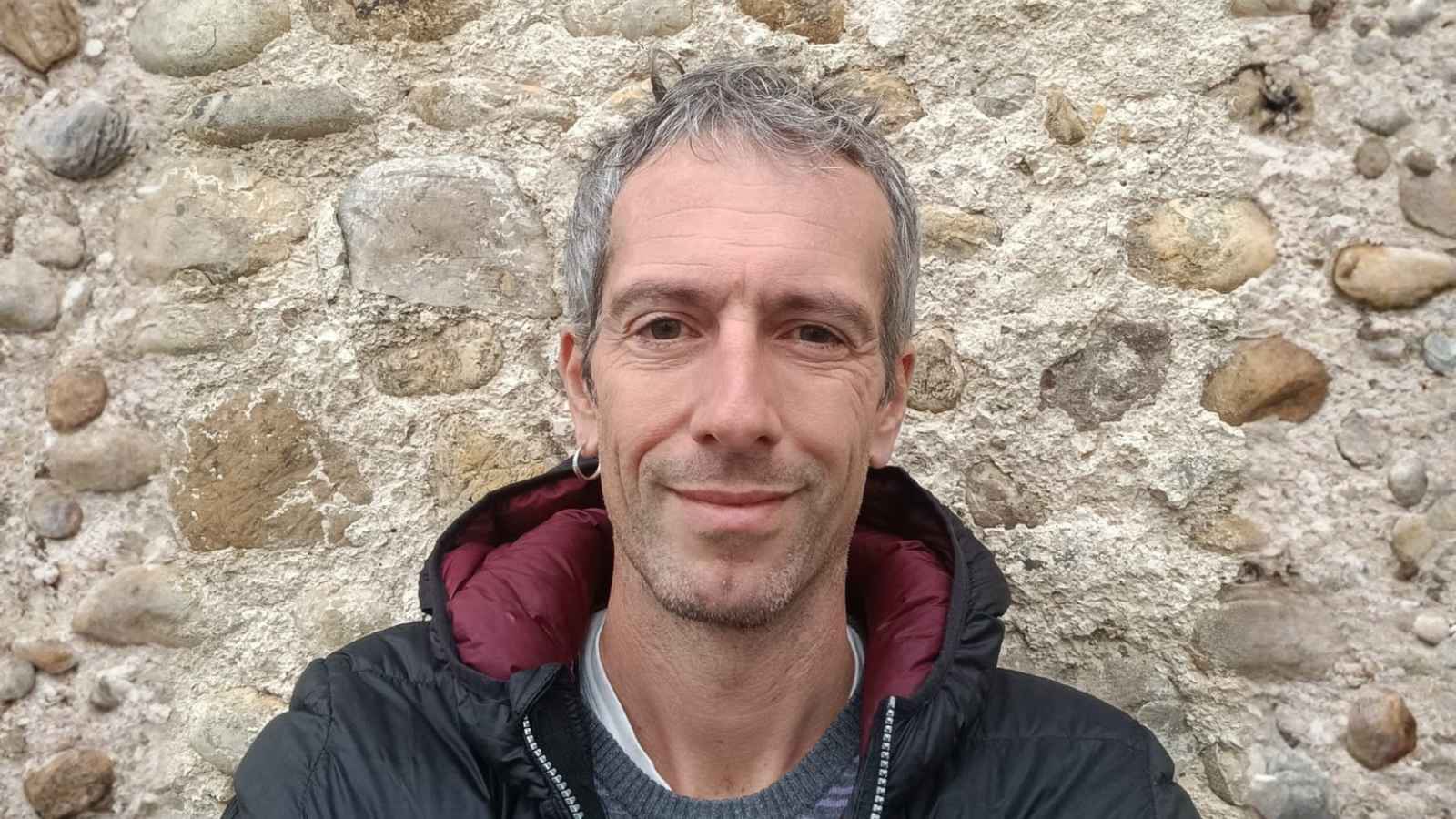
Interview to David Soler, geographer and co-host of the video podcast From Florence to Singapore, UAB alumnus of the Geography degree.
19/11/2026
David Soler, geographer and co-host of the video podcast From Florence to Singapore, UAB alumnus of the Geography degree.
When you were a student, did you imagine that you would end up launching a project like From Florence to Singapore?
Not at all. In fact, I started a degree in Economics at the UAB, but it was not what I expected and I lost interest. I was not sure what I wanted to study, so for a year I did various things until I started Geography at the UAB. In theory it was a five-year degree, but I ended up finishing it 13 years later.
What happened?
At first, I combined it with two different jobs and was always struggling to keep up, until I started taking it more seriously. With one subject left to complete, I went to the Netherlands to do a Master's in Urban Planning, where I met my partner. We returned to Barcelona. I was working but still had that subject pending until I received an email informing me that a new curriculum would begin and, if I did not pass the subject, I would have to retake around 100 credits. I knew what I had to do, enrolled online, and passed it.
What did the UAB give you that still accompanies you today in your professional and personal journey?
From a social perspective, a lot of life experiences. I met many people in class, in the bars, and through other activities, parties, and gatherings. Socially, it was very enriching. The UAB represented a major change because, until then, almost everyone I knew was from Mataró, and there I met people from all over Catalonia and beyond. It also provided me with academic training, enriched me with knowledge, I graduated, and it allowed me to access my first serious job at an archaeology company through an elective course I took during my degree.
Is there anything you remember that had a significant impact on you?
Apart from friendships I still maintain, thinking about academics, urban geography was a revelation. Especially thanks to Professor Francesc Muñoz, I fell in love with that field, to the point that I completed a Master's in Urban Planning and chose to direct my professional career in that area.
How has your career evolved?
After finishing my degree and master's, I worked as a cartographer in Mataró. Later, I decided to make a change and opened a bar-restaurant in Barcelona, where I spent almost three years. From there, I moved to Italy.
How was your professional start there?
At first it was difficult because I had no contacts. I kept searching, trying different things, and eventually entered the tourism sector, leading groups around Tuscany. For several years, I organized small tours and wine tastings.
And then?
I had the opportunity to enter the social services sector. I have changed cooperatives over the years, but I work in the same field on similar projects, welcoming refugee immigrants. I mainly focus on helping people with training and job-search support.
Nothing to do with geography.
More than one might imagine. Geography is a very versatile discipline. You have to create your own job opportunities or apply your knowledge to different fields. During the years I worked in tourism, I had to learn a lot about the territory, historical events, how to move around and reach places, and all of that was directly linked to territorial knowledge. Geography is always present, even if only in small doses.
How?
At work, while moving around the area. Besides that, I am the type of person who spent hours looking at paper maps as a child, and now I do the same with Google Maps. Knowing the territory is a vocation.
How long have you had this interest?
It has been a passion since I was six or seven years old, when I would pick up an atlas. I used to ask my parents to buy me atlases and geography or map books.
Why do you prefer digital maps now?
Sometimes I still look at the maps in books or fold-out maps I have at home, but for convenience I pick up my phone and open Google Maps. With the application, you can explore the entire world at different scales, and it even includes extra information about businesses, shops, and restaurants. It is endless and opens up many possibilities.
How often do you look at them?
Whenever I become curious about places that catch my attention, I look them up on the map afterward. Since starting the video podcast, when people talk to us about places, I often look them up later.
And before seeing where the person you are going to interview lives?
No. In fact, one of the characteristics of the video podcast is that we do not prepare the interviews. We do not search for information or look at maps beforehand.
How do you choose your guests?
That part is my responsibility. We started by contacting people we already knew. Later, I became more proactive in searching. One contact who has opened many doors for us is Sergi Marzábal, manager of the Catalans al Món platform. That is probably the hardest part: reaching people, especially younger ones. It is quite an adventure.
How did you imagine the podcast would be?
We are clear that it is a long-term project and that it needs time. We have only been doing it for a year and already have around twenty episodes. It is a shame that we cannot dedicate as much time to it as we would like. We both have families, jobs, and the added difficulty of a seven-hour time difference, which sometimes limits us. We would love to record and publish every week.
What are you learning through the podcast?
A huge amount. It gives us the opportunity to meet people who explain what the places where they live are like, what they do, and interesting facts. We are also learning how the podcast universe works, from editing to understanding how to monetize it, although we are still at a very early stage.
Do you see it as a privilege?
Absolutely. AI can explain everything nowadays, but it is not the same as hearing from a real witness, someone who tells you how they live, their difficulties, joys, and experiences. It is a privilege. One of our goals is to reach people who are unsure about moving abroad and living that experience. Being able to listen to someone explain what it is really like is priceless.
You and Manel have been hosting the podcast together for a long time. What is the secret to making a friendship and a shared project work for so many years?
Enthusiasm and friendship. It is the perfect excuse to keep meeting. We have known each other since we were ten years old and have always stayed in touch, even now that we live thousands of kilometers apart. Knowing each other and being able to empathize with potential difficulties makes things easier.
Many of the people you interview talk about the difficulties of living far from their loved ones. How have you experienced it?
I would recommend the experience to everyone, even if only for a short period. It is extremely enriching. When you move to another country, you discover a new culture and a different way of doing things. You have to learn many things from scratch and overcome challenges that help you grow. At the same time, not having ties that condition you gives you an incredible sense of freedom.
Have you ever doubted whether it was worth continuing to live abroad?
My partner and I have always been open to returning to Catalonia or even living elsewhere in the world. Sometimes, when you have children, you wonder whether it is right to take them away from their environment, especially when adolescence approaches, but you never know.
What do you miss most about Catalonia?
Living in Italy, I feel very close to Catalonia in many ways: the lifestyle, gastronomy, culture, and even the language. But I miss Barça. Here nobody cares about what Barça does, and I miss sharing my passion for my club.
What would you say to a UAB student who is considering studying abroad but does not dare take the leap?
Go for it, without hesitation. They can watch our video podcast; I am sure it will help them decide, one way or another.
What lessons does an international experience offer?
Besides the language, you learn many other things. You have to manage on your own away from home, understand how everything works, the healthcare system, relationships, where to shop... It represents tremendous personal growth.
Recommend a place in Tuscany.
Lucca is one of its gems. A small Italian city that is very lively, full of culture, music, commerce, and craftsmanship, with a spectacular walled historic center. It has the widest city walls in Italy. A fantastic place to discover.
What is your relationship with tourism?
It is a sector that I enjoy both as a customer and as a worker. When you are younger, it is fantastic to work in tourism if you have fewer ties or family commitments. It allows you to be outdoors, constantly on the move, visit beautiful places, learn, and meet people. On the other hand, it also requires language skills and learning about history, culture, and gastronomy. In places like Tuscany, where tourism is highly seasonal, winters are quieter, but in summer you never stop. Spending many hours away from home and far from family can eventually lead to burnout. That is what made me decide to change sectors.
If you left Italy, what would you miss?
The gastronomy is outstanding. In Italy there is a strong commitment to achieving the highest quality, especially in gastronomy, artisanal products, and certain services. You become accustomed to certain things very quickly, and I would miss them.
What would you be happy to leave behind?
The bureaucracy. It is a tiring system, with certain things organized in a way that lacks flexibility and dynamism.