
The oldest and most complete Homo habilis skeleton
A recent study published in The Anatomical Record describes a new partial skeleton known for Homo habilis, the earliest named species in the genus Homo. Despite being within the human genus, the fossil skeleton retained ape-like, primitive upper limb features, yet hints at lower limb features related to human-like bipedality. This study included multiple leading institutions, including the Institut Català de Paleontologia Miquel Crusafont (ICP-CERCA).
Homo habilis is a species of fossil human (a hominin) that lived in Africa from ~2.5 to 1.4 million years ago, and is often interpreted as the ancestor of Homo erectus. Homo habilis is the earliest species assigned to the genus Homo, yet very little is known about its skeleton beyond the skull (the so-called postcranium). Postcranial bones provide valuable information about the locomotor habits, limb proportions, and body sizes of fossil hominins. In the case of Homo habilis, there are only 3 instances where postcranial bones have purportedly been found in direct association with diagnostic craniodental material (OH 7 and OH 62 in Tanzania, and KNM-ER 3735 in Kenya). This scarcity has strongly limited what we can infer about the origins of our genus. In particular, it has made it difficult to understand how early Homo moved, and how its locomotion differed from that of earlier australopithecines and later humans. Earlier species such as Australopithecus afarensis (Lucy’s species) combined upright walking with climbing abilities, whereas later members of the genus Homo, such as Homo erectus (represented by the famous “Turkana Boy”), were fully adapted to long-distance walking on the ground.
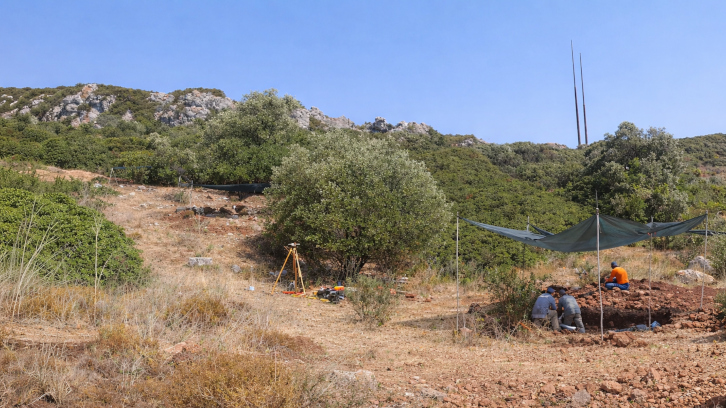
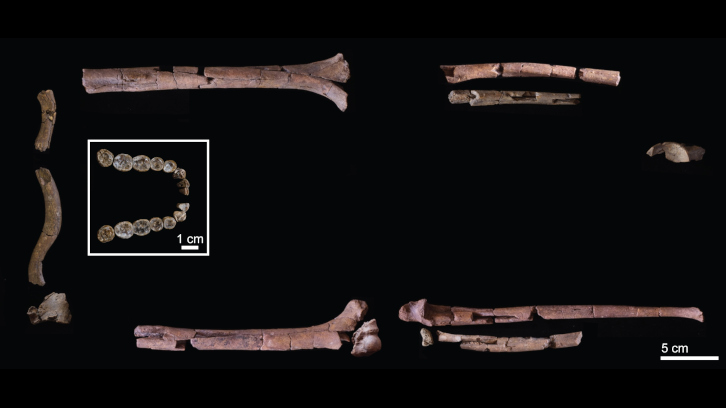
KNM-ER 64061 is a partial skeleton recovered from 2.02–2.06 Ma deposits of the Koobi Fora Formation in northern Kenya. The skeleton is associated with a nearly complete mandibular dentition attributed to Homo habilis. The first fossils were found in 2012 and 2013 by a team led by Meave Leakey, ultimately retrieving the collarbone, shoulder, arms, and fragments of the pelvis. The proportions of the KNM-ER 64061 forearm (ulna and radius) relative to its upper arm (humerus) support previous interpretations that H. habilis had a relatively long ape-like forearm similar to Australopithecus. All upper limb elements possess thick cortices compared to modern humans, indicative of more intensive use of their arms. Although KNM-ER 64061 does not preserve a lower limb, small portions of the pelvis were preserved. Features of the ischium suggest that the hamstring muscles function was more similar to Homo than to Australopithecus. When humeral regression formulae for stature are applied to this fossil, this specimen’s stature (160 cm) is intermediate in height between other H. habilis specimens and those of H. erectus. The body mass (30.7–32.7 kg) of KNM-ER 64061 is estimated to have been substantially less than H. erectus.
In summary, KNM-ER 64061 is the oldest and most complete H. habilis skeleton recovered thus far. The skeleton shows us that H. habilis retained more primitive proportions and was smaller in stature and mass than H. erectus. The very fragmentary ischium of KNM-ER 64061 suggests more derived walking mechanics compared to earlier Australopithecus, a feature which may have enabled the capacity for long-distance travel that appears to have been an important adaptation in later Homo erectus. However, KNM-ER 64061 does not preserve lower limb bones such as the femur or tibia, which could greatly change our interpretation of walking capabilities, interlimb proportions, and the stature and weight of this species.
KNM-ER 64061 highlights how mosaic and complex the early evolution of the human body was—and how much remains to be discovered about the origins of our own way of moving through the world. Advancing our understanding of adaptations in early Homo now depends on finding lower limb bones that can be clearly associated with craniodental materials of the human genus.
Institució Catalana de Recerca i Estudis Avançats (ICREA)
Institut Català de Paleontologia Miquel Crusafont (ICP-CERCA)
Universitat Autònoma de Barcelona
References
Grine, F. E., Yang, D., Hammond, A. S., Jungers, W. L., Lague, M. R., Mongle, C. S., Pearson, O. M., Leakey, M. G., and Leakey, L. B. (2026). New partial skeleton of Homo habilis from the upper Burgi Member, Koobi Fora Formation, Ileret, Kenya. The Anatomical Record. https://doi.org/10.1002/ar.70100