Iron nanoparticles for anaerobic digestion: not all that glitters is gold
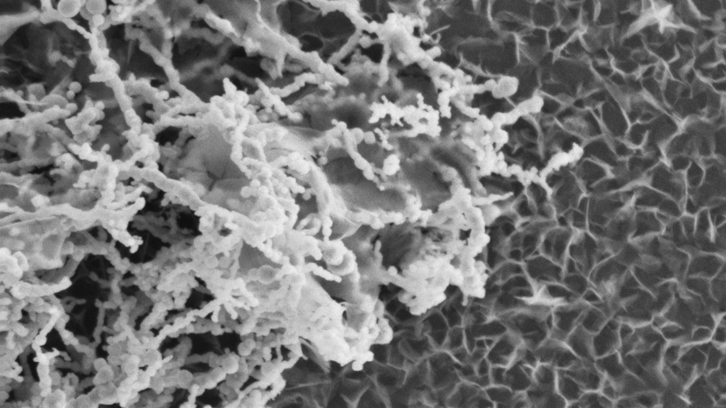
The Department of Chemical, Biological and Environmental Engineering has investigated whether wastewater sludge produces more biogas when additional iron nanoparticles are added during the water treatment process. The results are mixed: it is not simply a matter of “adding iron” but of finding the right balance between the different components.
When we talk about wastewater treatment plants, we often think only about cleaning water, but this process is accompanied by the generation of other residual streams that must be properly treated. One of these residual streams is what we call “wastewater sludge”, which still contains organic matter and microorganisms coming from the water treatment process itself. This sludge can be valorised through anaerobic digestion, where millions of microorganisms, in the absence of oxygen, transform this residual stream into biogas. This biogas is a gas with a high methane content and, therefore, a renewable energy source that can replace part of the fossil gas (natural gas) we use. Thus, anaerobic digestion is one of the key pieces of the energy transition towards a more sustainable economy.
From GICOM research group at the UAB, together with the University of Almería, we posed a very specific question: can we help these microorganisms produce more biogas by adding iron nanoparticles? To answer this question, in our study zero valent iron nanoparticles (nZVI) were used, which have the ability to donate electrons and favour chemical reactions. In fact, earlier simple laboratory tests had already shown that their addition can increase the methane content of the biogas. Moreover, many articles report significant increases in biogas production using these nanoparticles, although the published studies have been carried out in batch processes, in the laboratory, and under conditions far removed from industrial ones. Therefore, what was unknown was what would happen when nZVI were used under conditions closer to the reality of a wastewater treatment plant, where the sludge continuously fed into the digester changes in composition over time depending on the treatment plant’s operation. So, the real question was: would the nZVI still be as efficient under these conditions?
To investigate this, we ran for almost a year operating six laboratory scale digesters fed with sludge from a real wastewater treatment plant and working continuously, as an industrial reactor would. In some digesters nZVI were added at different doses and in others they were not, allowing the effect of the nanoparticles to be compared under the same conditions. Over the course of the process, the amount of organic matter removed, the quantity of biogas produced, the percentage of methane in that biogas, and even the changes in microbial communities over time were measured.
The results are neither black nor white, but they are still interesting. On one hand, the addition of nZVI consistently increased the methane concentration in the biogas by 3–11%, and it was found that this increase was proportional to the dose of nZVI applied. On the other hand, however, total biogas production decreased by 4–14%. In other words, the amount of biogas produced goes down, but it is richer in methane. This means that methane yield (the total amount of methane produced) improves only slightly, or even decreases, depending on the combination of dose and operating conditions. Although there is no clear increase in methane production, the fact that the methane concentration in the biogas rises is highly relevant, as it can facilitate subsequent processes for purifying the methane present in the biogas and thus enable its injection into the natural gas grid.
It has been concluded that a key piece of the puzzle is the organic loading rate, that is, the amount of organic matter introduced into the digester each day. When this loading is moderate, the nanoparticles appear to help methane producing microorganisms work better, and the system benefits. However, when the loading is too high, the positive effect is diluted or can even reverse. This reduced effect when the organic loading increases is probably due to the nanoparticles ageing rapidly or becoming covered by organic matter so that they can no longer perform their role. This suggests that it is not simply a matter of “adding iron”, but of finding an appropriate combination between the organic loading and the nanoparticle dose.
Department of Chemical, Biological and Environmental Engineering
Universitat Autònoma de Barcelona
References
Moyano, D., Vargas-García, M. D. C., Barrena, R., Sánchez, A., & Font, X. (2026). Assessing the impact of zero-valent iron nanoparticles on the semi-continuous anaerobic digestion of sewage sludge under the inherent variability of the influent. Journal of Environmental Chemical Engineering, 14(2), 121806. https://doi.org/10.1016/j.jece.2026.121806