
Graphene electronic devices perform differently in aqueous media
Research carried out by the Catalan Institute of Nanoscience and Nanotechnology (ICN2), with researchers from the UAB, has shown that the performance of graphene-based electronic devices in aqueous media can vary. This may have implications when applying it to industry and must be considered.
Since graphene first experimental isolation in 2004, numerous studies have reported on its unique combination of electronic, mechanical, chemical and optical properties. Profiting from this basic research, graphene-based electronic devices are nowadays investigated for a wide range of applications, including biomedicine.
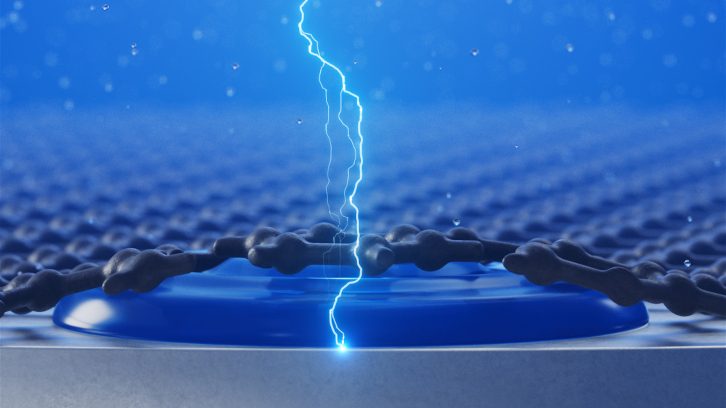
For these applications, graphene is aimed to work in contact with an aqueous media, typically an electrolyte, while maintaining its structure and enabling long-term functionality and stability. Several works have highlighted the importance of knowing how the electrolyte properties, composition, and ionic strength, may impact its electronic properties and, subsequently, its applications. However, these studies focus solely on water on the graphene surface, without considering that water can intercalate, becoming trapped beneath the graphene surface and its substrate.
The phenomenon of water intercalation is inevitable, although its magnitude depends on the quality of the graphene, as water has been observed to penetrate through grain boundaries. The physical properties of this intercalated water differ from those of the electrolyte and are governed by the chemical and electrical nature of the substrate. Therefore, understanding and controlling the role of intercalated water in devices designed to operate in aqueous media, as is the case in biomedical applications, is of great importance for achieving optimal performance of graphene electronic devices.
In this work, we carried out an exhaustive study of the interfacial phenomena governing the substrate-graphene-electrolyte system. We developed a set of in-situ characterization techniques, along with mathematical modeling, that allowed us to observe the modulation of the graphene optoelectronic properties while the electronic devices operate. We designed and fabricated graphene devices on substrates with similar morphology but very different conductivity, dielectric and semiconductor.
We observed that, although water intercalates between graphene and substrate in a similar manner in both systems, the impact on device performance is very different. In the case of graphene on an insulating substrate, the intercalated water does not alter the performance, and the device displays the typical graphene´s ambipolar character. In contrast, when graphene is on a conductive substrate, the intercalated water generates a direct electrical connection between the substrate and the electrolyte, masking the characteristic electrical behavior of graphene.
In conclusion, the substrate supporting graphene in electronic devices operating in aqueous environments substantially influences its behavior and must therefore be carefully considered when designing the fabrication processes for diverse applications. Being graphene a one-atom thick material, advancing knowledge about interfacial phenomena, as water intercalation, is crucial for standardizing and transferring this burgeoning technology to industry.
Marta Delgà-Fernández and Elena del Corro
Catalan Institute of Nanoscience and Nanotechnology (ICN2)
Universitat Autònoma de Barcelona
References
M. Delgà-Fernández, A. Toral-Lopez, A. Guimerà-Brunet, A.P. Pérez-Marín, E.G. Marin, A. Godoy, J.A. Garrido, E. del Corro (2025). Interfacial Phenomena Governing Performance of Graphene Electrodes in Aqueous Electrolyte. Nano Letters 24, p. 11376-11384. https://doi.org/10.1021/acs.nanolett.4c01808.