
Can the 15-minute city affect housing affordability?
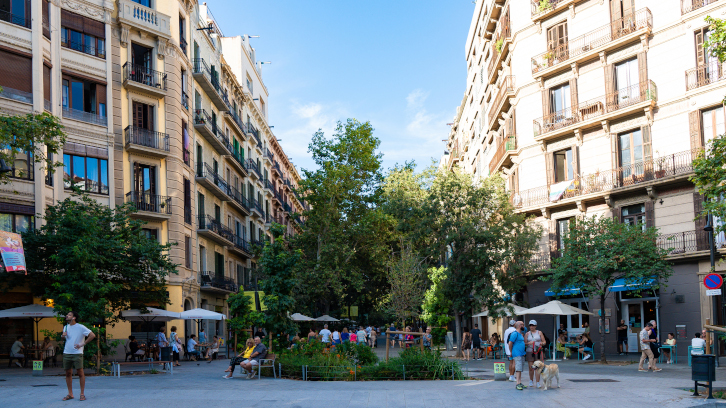
A recent study by UAB examines how proximity to everyday destinations is related to rental prices in four Spanish cities that already display characteristics associated with the so-called "15-minute city": Barcelona, València, Palma and Granada.
In recent years, the 15-minute city model has gained prominence in urban planning debates as a strategy to improve urban quality of life, reducing the need for long commutes and facilitating access to basic services (such as retail, educational centres or healthcare facilities) within a short distance from home. However, we still know little about how these types of urban configurations may influence access to housing.
Map of Barcelona with the relationship between greater or lesser proximity and rental prices.
Our study addresses precisely this question by examining the relationship between proximity to daily services and rental prices using spatial analysis techniques and segmented regressions that capture differences within each city and across different types of urban structure.
The results show that this relationship is considerably more complex than is often assumed:
- Although with important nuances, proximity to everyday services tends to be capitalised as a premium in the rental market. In other words, living close to amenities and services is generally reflected in housing prices, although this effect depends on the existing level of accessibility and the specific urban context.
- However, educational and care facilities do not follow this general pattern: greater proximity to these services is systematically associated with lower rental prices.
- The relationship between proximity and rental prices is clearly non-linear. In the most accessible areas, rents tend to increase as proximity to services improves. However, in areas with intermediate levels of accessibility, the opposite occurs: greater proximity is associated with lower prices. In the least accessible areas, prices increase slightly again as accessibility improves.
- The spatial distribution of this relationship differs between monocentric and polycentric urban systems. Thus, in monocentric cities such as Palma or Granada, everyday proximity tends to be concentrated in urban centres, where the highest real estate prices are also found. By contrast, in polycentric cities such as Barcelona, different neighbourhoods may function as urban subcentres, offering very short daily distances at low, medium and high price levels, indicating that accessibility does not translate uniformly into real estate value.
Overall, these findings suggest that while improving everyday accessibility may contribute to more sustainable and liveable cities, it may also have implications for housing affordability and, ultimately, for the social composition of neighbourhoods. Incorporating this dimension into urban policy design could be key to preventing the benefits of proximity from being distributed unevenly.
Department of Geography
Research Group in Mobility, Transport, and Territory
References
Villar-Abeijón, P., Miralles-Guasch, C., & Marquet, O. (2026). The impact of proximity to amenities on housing affordability: Insights from Mediterranean 15-minute cities. Cities, 172, 106859. doi: 10.1016/j.cities.2026.106859.